I've just realised how long it is since I last blogged. I knew I'd been ill for a while but I didn't realise it'd been nearly 6 months.
You know that feeling when you've eaten a huge, huge, meal (e.g. on Xmas day): You feel exhausted because all your blood has rushed to your stomach leaving no energy for the rest of your body to do anything. But at the same time you can't sleep because your digestive system is working so hard. And of course you can't force any food down because you already feel like you're going to explode. Normally the sensation only lasts a couple of hours until your system has made good progress of dealing with the oversized meal.
I've felt like that since the beginning of June. I've spent much of the summer depending on meal replacement drinks because I couldn't force any food down. I've had no energy to do anything (e.g. blog) because my digestive system has been being so irrational and I've also not been sleeping because of the digestive mania which has been increasing the sensation of exhaustion.
Despite the fact that I'd much rather be lazing, watching telly and eating Cadbury's Deadheads (because they're the only thing I've managed to eat today without ending up bent barfing over the bog within 60 seconds) I felt I had to quickly comment about this week's Ricky Gervais mong twitstorm. Everyone else is blogging about it and I just love a bandwagon.
It seems a lot of people don't know the origin of the word, so in a nutshell: It's an impairment-specific insult and refers to people with Down's Syndrome. In the 1860s Dr John Langdon Down decided to classify people with learning difficulties by "which country they looked like they came from" (really!) and he thought people with an extra 21st chromosome looked like they came from Mongolia so named the condition 'Mongolism'. (Later renamed after Dr Down because the Mongolians took offense.) So 'mong' isn't really associated solely with people with DS, it's also a slightly racist term with regards to citizens of Mongolia.
Gervais apparently thinks he has some kind of "right" to reclaim the word "mong"; despite the fact that - as far as I'm aware - he does not have Mongolian citizenship. He maintains that the definition of mong has moved on and it's no longer anything to do with Down's. Though that argument loses credence when you realise that 4 hours later he posted a tweet using the word "twongols", clearly derived from the term "mongols" further establishing the link between "mong" and the outdated diagnosis of mongolism.
It's been quite big news with most papers and radio shows discussing whether or not "mong" is offensive to people with Down's. I've seen quotes from Nicky Clark, Richard Herring and Christina Martin on the offensiveness debate. Odd thing is: They're all non-disabled. Don't get me wrong, they're all great disability rights activists and I value their contributions to making the world a slightly better place. I'm constantly pointing out how much we need non-disabled people to give a crap about disability issues. So I'm gonna repeat it and italicise it this time to really drive home my point: they're all great disability rights activists and I value their contributions. And I have no issue with them giving their opinions on these issues when asked for them.
But it's odd that when the subject is "is mong offensive to people with Down's Syndrome?" That the only people being asked for their opinion on the subject are non-disabled disability rights activists. Radio presenters would never ask "is using 'gay' as a pejorative offensive to homosexuals or has the meaning of the word changed?" Without including LGBT folk in the debate. So why aren't people with Down's Syndrome invited onto the radio to discuss how they feel about Gervais's words? Why is it only non-disabled people who are being asked for their opinion? That's the bit that bothers me; not that non-disabled people are giving their opinions, but that people with Down's are not being asked.
Not only is the exclusion of people with Down's from a debate about Down's almost as problematic as Gervais's original tweets, it also seems like a circular discussion that we'll never reach the end of. People without Down's can express their opinions but until we ask people with Down's Syndome "does mong offend you?" We'll never have a definitive answer to the question "is mong offensive to people with Down's Syndrome?" AOL can run polls asking the general populace their opinion but until people with an extra 21st chromosome are included in the debate it's all very abstract and inconclusive.
I'd be particularly interested to hear the opinion of actor Russell Ramsay who was in an episode of Extras so having worked with Gervais probably has an insight into both sides of the debate. (Random fact: When I was a child my parents would drag me kicking and screaming to church every week. I went to Sunday School with Russell. Haven't seen him in at least 20 years though.)
Despite the fact that we haven't yet got a conclusive answer as to whether or not people with Down's find "mong" offensive today (because they haven't been asked) the history of the word is clearer: It's historically a term of abuse and a form of hate speech. Disablist hate crime is on the up due in no small part to the bullshit rhetoric being peddled by the government and press in attempt to whip up support for welfare reform. People are getting called a "scrounging cunt" in the street or being followed down the road by someone shouting "fucking DLA stick" at them. That Gervais is using an historically abusive term so liberally and encouraging his fans to use it is pouring fuel on the already raging fires of hate. Ironically Gervais is calling people who disagree with him "haters" and stipulating that they only disagree with him because they're jealous of his success. If being successful means that you feel superior to members of oppressed minorities and have a licence to use abusive language then I'd rather remain unsuccessful but a decent human being.
20 October 2011

06 May 2011
♫...So scared of breaking it that you won't let it bend...♫
There's an awareness day for everything these day. And so today is that day for my mobility impairment. Today is Wishbone Day, raising awareness of osteogenesis imperfecta.
There are lots of mythconceptions about OI around. Most notably the lies peddled in the dreadful M. Night Shyamalan film Unbreakable. Despite it being 11 years old, and you'd think most people would expel a film that dire from their memory, I still get people saying "oh, like in Unbreakable?" When they find out I have OI.
No. Not like in Unbreakable. For starters when Samuel L Jackson "explains" OI in the film he claims that type I is the mildest and it's a spectrum through to type IV which is the most severe and usually fatal at birth if not before (no mention of types V to VIII but I think at least some of those hadn't been discovered then). I am a 31 year old type IV. My mum who was also a type IV made it to 70 before dying from her familial predisposition to drop dead from heart failure at a reasonably young age. OI was not a contributing factor in her death.
It's actually type II that's fatal. Type III is usually pretty severe. Type IV varies from very mild to almost as severe as type III. Type I is different to the other 3 well established types. Bone breakage in types II, III and IV is the result of poor quality collagen. Collagen being the protein that provides reinforcement for bones. Type I is the result of a lack of collagen rather than the right amount of crappy quality collagen so it's quite different to types II - IV. There are type ones around who've had more fractures than me so to claim it's the "mildest" type is untrue.
There are many other inaccuracies in the film. By casting a non-disabled actor to play a person with OI he was, unsurprisingly, lacking all the physical characteristics of the condition. Elijah says he's had about 50 fractures; roughly the same number as me. Medical care of people with OI is constantly improving and Elijah was much older than me so he would've had worse medical care than I did when I did the bulk of my breaking as a child. Between not being very sturdy to begin with and then being constantly broken; bones with OI tend to bend. The bones in my right forearm have a bend in the middle of about 80°. The bones in my left leg are bent to about 30°. Had a I received the medical treatment a child with OI would receive today my bones would be less bent. They probably wouldn't be as straight as a person without OI's, but they'd be straighter than they are.
Elijah, being roughly the same as me in severity, should have bent bones. Bones bent more than mine because even less effort would've gone into straightening them. Samuel L Jackson not having OI has perfectly straight bones. Total credibility fail.
The other glaringly obvious characteristic fail is the eyes. Because collagen is the protein that makes the whites of your eyes white, most people with OI have blue scleras. Most, but not all. However, the people that do have white scleras are not type ones. Types ones always have blue scleras (like I said, it's different to the other types). SLJ does not have blue scleras. They could've made his scleras appear blue of course, in many films and TV shows you have demons and other monsters with completely black eyes. Tinting SLJ's scleras wouldn't have been too hard, whether through contacts or SFX in post-production.
So, yes. My impairment is nothing like Jackson in Unbreakable. Also, spending a lot of time in hospital as a child doesn't turn you into a terrorist.
Unbreakable isn't the only film to peddle poor facts about OI. Amélie is considered by many to be a piece of loveliness. It made me want to punch my TV screen. Amélie's neighbour with OI lives in a padded flat. Though perhaps I could do with his padded tellybox so that if I did end up punching it in frustration I'd be less likely to break my fist.
People with OI do not live in padded houses. There's no point. Breaking your bones is such a random thing. I've fractured my spine while sleeping on something soft and padded whilst conversely I've gotten drunk, fallen down a flight of steps in a club, and not broken a thing. Over-cautiousness can actually result in a reduction in bone density so living in a padded house can make you more, not less, likely to break.
I'm a big fan of forensic TV shows so obviously I watch Bones. OI has cropped up a couple of times, once just as a mention with regard to some ancient bones that Brennan had been looking at. In the episode "The Truth in the Lye" in season 2 they found some bones in a bathtub on a building site. Brennan looked at the bones under a microscope and noticed the lack of collagen.
The big fact fail here was with regard to reproducing. Bones said that in all the other types OI is the result of a spontaneous mutation but sometimes it's inherited in type ones. Hello! Type IV child of a type IV right here! And I'm not unique, I know tonnes of types IIIs and IVs who've had kids. When a person with OI has a child there's a 50% chance of the child inheriting it. Yes, OI is often caused by a spontaneous mutation. In the case of my family my mum was the mutant and I inherited it from her. But claiming that it's only type ones that breed is ludicrous.
The most common storyline when OI crops up in film and TV is that of parents being falsely accused of abuse. It's been done in Home & Away, ER, Casualty and many more shows.
It's an incredibly serious issue and unlike the other OI storylines I've mentioned it's one that's usually fairly realistically represented.
The Home & Away storyline was in the days when Pippa had a house full of foster kids. She fostered a child who'd been taken away from his parents because his recurrent broken bones had led to his parents being accused of abuse. Whilst in Pippa's care he broke his arm. Pippa took him to the local hospital where he was treated by a doctor who didn't sleep through the lecture on OI in her medical training. She diagnosed him and he was returned to his parents.
In ER Carter treated a kid who'd been brought in with a persistent cough. A chest x-ray revealed numerous broken ribs. Carter ordered full body x-rays and found that the kid had old and healed, currently healing, and fresh fractures all over. Carter called the police and social services claiming the mother had been beating the child. Carter performed a lumbar puncture on the baby and then took some more x-rays. Looking at the second set of x-rays Carter noticed that there was a new rib fracture not on the first set of x-rays and realised he'd broken one of the kid's ribs whilst doing the lumbar puncture. This resulted in him diagnosing OI and calling off the hounds.
In real life however, these stories don't always have a happy ending with the kids being returned to their parents. In some cases the children end up being adopted before diagnosis and adoption orders cannot be undone. Even when the child is returned to the parents it's often after the psychological scars of the child being fostered have been inflicted on both parents and child.
These days there are many diagnostic tests available for OI, there's no need for families to be destroyed. But it still happens because doctors don't think to check for it and social workers - in this target-driven post-Baby P era - don't mention it because they're desperate to whisk kids away from parents to meet their targets for kids fostered.
Wishbone Day could be a wonderful way to target doctors and social workers, to make them aware of OI, the clinical presentation, how to differentiate it from abuse, and how to test for it. But from what I've seen that level of awareness-raising aimed at the people who need it isn't happening. It's seems the thrust of Wishbone Day is "wear yellow and do the Facebook status meme," which isn't going to raise awareness amongst the people that need to be made aware. I'm aware that even this post picking apart media myths of OI is slightly redundant because it'll mostly only be read by people that know me so aren't gonna be taken in by Shyamalan's bullshit. So I'm being no more helpful to the cause than those who are simply changing their Facebook status and I throw my hands up and admit that. We need awareness targeted where it matters: A&E staff and social workers. Until that happens I think Wishbone Day is a bit wishy washy.
There are lots of mythconceptions about OI around. Most notably the lies peddled in the dreadful M. Night Shyamalan film Unbreakable. Despite it being 11 years old, and you'd think most people would expel a film that dire from their memory, I still get people saying "oh, like in Unbreakable?" When they find out I have OI.
No. Not like in Unbreakable. For starters when Samuel L Jackson "explains" OI in the film he claims that type I is the mildest and it's a spectrum through to type IV which is the most severe and usually fatal at birth if not before (no mention of types V to VIII but I think at least some of those hadn't been discovered then). I am a 31 year old type IV. My mum who was also a type IV made it to 70 before dying from her familial predisposition to drop dead from heart failure at a reasonably young age. OI was not a contributing factor in her death.
It's actually type II that's fatal. Type III is usually pretty severe. Type IV varies from very mild to almost as severe as type III. Type I is different to the other 3 well established types. Bone breakage in types II, III and IV is the result of poor quality collagen. Collagen being the protein that provides reinforcement for bones. Type I is the result of a lack of collagen rather than the right amount of crappy quality collagen so it's quite different to types II - IV. There are type ones around who've had more fractures than me so to claim it's the "mildest" type is untrue.
There are many other inaccuracies in the film. By casting a non-disabled actor to play a person with OI he was, unsurprisingly, lacking all the physical characteristics of the condition. Elijah says he's had about 50 fractures; roughly the same number as me. Medical care of people with OI is constantly improving and Elijah was much older than me so he would've had worse medical care than I did when I did the bulk of my breaking as a child. Between not being very sturdy to begin with and then being constantly broken; bones with OI tend to bend. The bones in my right forearm have a bend in the middle of about 80°. The bones in my left leg are bent to about 30°. Had a I received the medical treatment a child with OI would receive today my bones would be less bent. They probably wouldn't be as straight as a person without OI's, but they'd be straighter than they are.
Elijah, being roughly the same as me in severity, should have bent bones. Bones bent more than mine because even less effort would've gone into straightening them. Samuel L Jackson not having OI has perfectly straight bones. Total credibility fail.
The other glaringly obvious characteristic fail is the eyes. Because collagen is the protein that makes the whites of your eyes white, most people with OI have blue scleras. Most, but not all. However, the people that do have white scleras are not type ones. Types ones always have blue scleras (like I said, it's different to the other types). SLJ does not have blue scleras. They could've made his scleras appear blue of course, in many films and TV shows you have demons and other monsters with completely black eyes. Tinting SLJ's scleras wouldn't have been too hard, whether through contacts or SFX in post-production.
So, yes. My impairment is nothing like Jackson in Unbreakable. Also, spending a lot of time in hospital as a child doesn't turn you into a terrorist.
Unbreakable isn't the only film to peddle poor facts about OI. Amélie is considered by many to be a piece of loveliness. It made me want to punch my TV screen. Amélie's neighbour with OI lives in a padded flat. Though perhaps I could do with his padded tellybox so that if I did end up punching it in frustration I'd be less likely to break my fist.
People with OI do not live in padded houses. There's no point. Breaking your bones is such a random thing. I've fractured my spine while sleeping on something soft and padded whilst conversely I've gotten drunk, fallen down a flight of steps in a club, and not broken a thing. Over-cautiousness can actually result in a reduction in bone density so living in a padded house can make you more, not less, likely to break.
I'm a big fan of forensic TV shows so obviously I watch Bones. OI has cropped up a couple of times, once just as a mention with regard to some ancient bones that Brennan had been looking at. In the episode "The Truth in the Lye" in season 2 they found some bones in a bathtub on a building site. Brennan looked at the bones under a microscope and noticed the lack of collagen.
The big fact fail here was with regard to reproducing. Bones said that in all the other types OI is the result of a spontaneous mutation but sometimes it's inherited in type ones. Hello! Type IV child of a type IV right here! And I'm not unique, I know tonnes of types IIIs and IVs who've had kids. When a person with OI has a child there's a 50% chance of the child inheriting it. Yes, OI is often caused by a spontaneous mutation. In the case of my family my mum was the mutant and I inherited it from her. But claiming that it's only type ones that breed is ludicrous.
The most common storyline when OI crops up in film and TV is that of parents being falsely accused of abuse. It's been done in Home & Away, ER, Casualty and many more shows.
It's an incredibly serious issue and unlike the other OI storylines I've mentioned it's one that's usually fairly realistically represented.
The Home & Away storyline was in the days when Pippa had a house full of foster kids. She fostered a child who'd been taken away from his parents because his recurrent broken bones had led to his parents being accused of abuse. Whilst in Pippa's care he broke his arm. Pippa took him to the local hospital where he was treated by a doctor who didn't sleep through the lecture on OI in her medical training. She diagnosed him and he was returned to his parents.
In ER Carter treated a kid who'd been brought in with a persistent cough. A chest x-ray revealed numerous broken ribs. Carter ordered full body x-rays and found that the kid had old and healed, currently healing, and fresh fractures all over. Carter called the police and social services claiming the mother had been beating the child. Carter performed a lumbar puncture on the baby and then took some more x-rays. Looking at the second set of x-rays Carter noticed that there was a new rib fracture not on the first set of x-rays and realised he'd broken one of the kid's ribs whilst doing the lumbar puncture. This resulted in him diagnosing OI and calling off the hounds.
In real life however, these stories don't always have a happy ending with the kids being returned to their parents. In some cases the children end up being adopted before diagnosis and adoption orders cannot be undone. Even when the child is returned to the parents it's often after the psychological scars of the child being fostered have been inflicted on both parents and child.
These days there are many diagnostic tests available for OI, there's no need for families to be destroyed. But it still happens because doctors don't think to check for it and social workers - in this target-driven post-Baby P era - don't mention it because they're desperate to whisk kids away from parents to meet their targets for kids fostered.
Wishbone Day could be a wonderful way to target doctors and social workers, to make them aware of OI, the clinical presentation, how to differentiate it from abuse, and how to test for it. But from what I've seen that level of awareness-raising aimed at the people who need it isn't happening. It's seems the thrust of Wishbone Day is "wear yellow and do the Facebook status meme," which isn't going to raise awareness amongst the people that need to be made aware. I'm aware that even this post picking apart media myths of OI is slightly redundant because it'll mostly only be read by people that know me so aren't gonna be taken in by Shyamalan's bullshit. So I'm being no more helpful to the cause than those who are simply changing their Facebook status and I throw my hands up and admit that. We need awareness targeted where it matters: A&E staff and social workers. Until that happens I think Wishbone Day is a bit wishy washy.
03 May 2011
The #no2av campaign's preying on the uneducated
I've just been talking to my dad on the phone. He has a postal vote so has already voted in the referendum.
My dad will be 77 in July. He grew up long, long, before disabled children had any right to be educated. He was ignored in mainstream school and then sent to a segregated college where he was taught nothing much. No-one taught him to read until a family friend took on the challenge when he was 21.
In addition to poor literacy due to no-one bothering to teach him until he was an adult he's almost certainly dyslexic. They didn't do much diagnosing of that during World War II.
In addition to that it's only been in the last 2 and a half years since my mum died that he hasn't had anyone living with him to help him understand things like the instructions on a polling card. He can read well enough to read the names on a card and identify which are his preferences. He can also count to three so would be capable of ranking his preferences in order.
One of the "no" campaign's loudest cries is that AV is too complicated for the masses. That you need to be some kind of genius to work out how to fill in a polling card under AV.
Out of fear that he wouldn't understand how to vote under AV; out of fear that AV is too confusing and too complicated, my father voted "no".
I am furious that the "no" campaign are preying on people like my dad by telling them they're too stupid to understand AV.
If my dad really believed that FPTP was a better system than AV I'd respect his choice. But that's not why he voted "no". The "no" campaign took advantage of his poor education, of his illiteracy, and his almost certain dyslexia by telling him that under AV he wouldn't be able to understand his polling card. They told him he was stupid and he believed it.
How many more people are going to be tricked into voting "no" because the campaign are preying on their poor education, their learning disability or insecurity about their intellect and telling them that they're just not smart enough to get it?
My dad will be 77 in July. He grew up long, long, before disabled children had any right to be educated. He was ignored in mainstream school and then sent to a segregated college where he was taught nothing much. No-one taught him to read until a family friend took on the challenge when he was 21.
In addition to poor literacy due to no-one bothering to teach him until he was an adult he's almost certainly dyslexic. They didn't do much diagnosing of that during World War II.
In addition to that it's only been in the last 2 and a half years since my mum died that he hasn't had anyone living with him to help him understand things like the instructions on a polling card. He can read well enough to read the names on a card and identify which are his preferences. He can also count to three so would be capable of ranking his preferences in order.
One of the "no" campaign's loudest cries is that AV is too complicated for the masses. That you need to be some kind of genius to work out how to fill in a polling card under AV.
Out of fear that he wouldn't understand how to vote under AV; out of fear that AV is too confusing and too complicated, my father voted "no".
I am furious that the "no" campaign are preying on people like my dad by telling them they're too stupid to understand AV.
If my dad really believed that FPTP was a better system than AV I'd respect his choice. But that's not why he voted "no". The "no" campaign took advantage of his poor education, of his illiteracy, and his almost certain dyslexia by telling him that under AV he wouldn't be able to understand his polling card. They told him he was stupid and he believed it.
How many more people are going to be tricked into voting "no" because the campaign are preying on their poor education, their learning disability or insecurity about their intellect and telling them that they're just not smart enough to get it?
01 May 2011
♫...Somebody tell me why I'm on my own, if there's a soulmate for everyone...♫
Written as part of Blogging Against Disablism Day 2011.
...Is a sentence I hear all the time. And it's such a load of horseshit. Women want me about as much as they want a particularly severe case of haemorrhoids and all the confidence in the world can't change that.
On the couple of occasions in life when someone that I don't find attractive has told me they fancy me (I'm 32 this month and it has really has only happened a couple of times) I've been flattered. My ego has been known to break into a little happy dance. But whenever I tell someone that I think they're hot their standard response is to never speak to me again. I really am that repellent to others. It's not being unconfident when people really do think you're repulsive.
But also I'm not lacking in self-esteem; I would totally go out with me. I think I'm smart, funny, reasonably charismatic, interesting, I always smell nice and I enjoy my own company. If anything I'm over-confident to the point of being delusional because it's clear that other people do not view those characteristics in me.
I spent most of my adult life trying to look at the world through "people are innately not disablist bastards" tinted glasses. I wanted to believe that the only reasons people were so repulsed by me were because I'm fat, ugly and annoying. Then I read the results of the 2008 Observer Sex Survey in which 70% of respondents said they'd never shag someone with a "physical disability". And that's only the people disablist enough to admit it to the man from Mori with a clipboard. You can be sure that, actually, many more people would never do one of us but they're too ashamed to admit it because they know that being prejudiced isn't cool.
Accepting that most people would never go out with me because they're disablist was, in a weird way, an exercise in self-acceptance. It made me take off those tinted glasses and accept that the reason I'm perpetually single and haven't had sex for [mumblemumble] years probably isn't because I'm fat, ugly, and annoying (even though I am) but it's because they're discriminatory arseholes.
Of course there are many, many, disabled people in healthy relationships. They managed to find people from that 30% who aren't so prejudiced. With there being so few decent people around I presume that 30% can pick and choose from whoever they want because they're good people. Which does then kinda come back round to the "I'm fat, ugly and annoying" thing. If they've got the pick of the crop then they've got absolutely no reason to choose me.
With gay/bisexual women being a small sector of the population, and only 30% of them being willing to date me on grounds of my impairment there's only going to be a couple of thousand women in the country who would be willing to go out with me. Then you have to take away those that are in relationships, those that wouldn't go out with me because I talk too much, those that might be willing to see past my impairment but wouldn't date a fatty, those who might be willing to give me a chance but geography would make a relationship impossible, etc and there's basically about 12 women left in the country that might be willing to go out with me. And what are the chances that our paths will ever cross or that they'll actually fancy me?
You might think "but surely lesbians would be less disablist than straight people. After all, they understand and experience prejudice too?" Last year a friend cajoled me into trying online dating. It was not a successful experiment. So many women say in their profile "no crazies" and one even said "no strange limps". Disablism is just as ubiquitous among gay people as it is among the rest of the population. And then of course there's all the other reasons women wouldn't want to be with me; they're only interested in skinny women, they have a minimum height requirement (though in my case that's also disablism, my impairment is a form of dwarfism), etc. The experiment lasted a month. I gave up.
Because I've been single for so long people now see me as asexual. Yes there's the general cultural myth that disabled people don't do it, but the perception of me personally goes over and above that. People who know better than to be mythtaken (for example disabled people or people who are currently/have previously dated a disabled person) see me as asexual too. People no longer introduce me to their single lesbian friends because they just perceive me as someone that's alone in perpetuity.
Another area where I think disability/disablism is an issue is around "who is gonna wanna go out with someone who's ill all the fucking time?" You plan a lovely romantic evening out and at the last minute I'm too ill to go. I promise I'm going to cook you an amazing dinner and you get home from work to find me curled up in bed clutching the morphine and gibbering incoherently because I'm in so much pain. You get a cold and know you're going to pass it on to me and that it'll render me useless for 3 weeks because my immune system is so knackered. The only possible perk to dating me is that you know when I say "not tonight love, I've got a headache" that I'm really telling the truth.
If I'd been in a relationship with someone when I got sick I think it'd be a different story, I don't think they'd have dumped me for being ill. But when someone's out looking for their perfect partner is "chronically ill" really going to woo them?
Of course, being too ill to go out a lot of the time and being too poor to go out all the time (because my weekly income on benefits is £67 a week short of the amount recommended by the Joseph Rowntree Foundation for a minimum standard of living.) does mean that my chances of crossing paths with those aforementioned 12 women who might be willing to give me a go is even slimmer.
Another thing that makes me unattractive is that I'm not good at being what I'm supposed to be. There's partly the fact that women are supposed to be quiet and nice and lovely, and I'm loud and sarcastic and rude. But the main issue is the disablist notions of what a disabled person is supposed to be. Disabled people are supposed to be seen and not heard. We're supposed to be all smiles and not tell people who patronise us to "fuck off". We're supposed to be grateful for scraps of access and not complain when we're treated unfairly. We're basically supposed to look and act like we've just rolled out of a Children In Need appeal.
I do make myself heard. All the time. I'm extremely loud and outspoken. I will swear at people who belittle me. I will complain about bad access or poor treatment. I'm rude and sarcastic and misanthropic. Even as a child I was never cute enough for CiN. Instead of getting picked for "make a wish" type trips to Disneyworld, I got banned from school holidays.
Last year I was at an academic conference and one of the speakers was talking about academic theories of cuteness. It was so interesting. One of the things she pointed out was that things that are considered cute are often rendered impaired and she gave the example of Hello Kitty not having a mouth. Hello Kitty is considered cute in part because she can't talk back. I talk back constantly and in a society that says disabled people should only be tolerated if they're adorable I'm a pariah.
As if all this wasn't enough to guarantee me a life of chronic singledom, I'm socio-economically unappealing thanks to the government's benefits bullshit which means that the only women I could ever live with are someone who is also on benefits or someone who's rich enough to "keep" me. And as anyone who's ever met me can confirm; I'm independent almost to the point of self-destructiveness. Me being a "kept" woman would almost certainly result in bloodshed.
At the moment if I were to move in with a partner who had a job I'd lose my Housing Benefit and my Income Support leaving me with my Incapacity Benefit for any contributions to running of the household and anything I wanted for myself (like my addiction to Lush). I'd also still have my DLA to cover the extra costs of being disabled. Losing Income Support would mean I'd lose my free prescriptions, my free NHS dentistry and my subsidised glasses. So I'd be a moderate financial burden on my other half.
But under the plans for Employment and Support Allowance (ESA) I'd only get to keep the non-means tested bit (the equivalent bit to Incapacity Benefit) for the first year of us living together. Then my only income would be my DLA, which is already accounted for because disability is expensive. I would be a total financial burden on my partner. "If we move in together you'll have to financially support me completely," isn't going to win hearts.
A couple of months ago I was having dinner with my doppelgänger/clone/mini-me. She's planning to move to London when she graduates from uni. She said that my inability to get a girlfriend worries her. She'd assumed that being a lesbian in London was like being a kid in a sweet shop. I think that's a really good analogy...
Imagine you're staying at your diabetic dad's sugar-free house. You're lagging in energy, you've got stuff you need to get done and you need a sugar fix. You find a slightly dusty Werther's Original in the back of a drawer. It looks a bit gross but you eat it because it's that or nothing.
Imagine you're in a sweet shop. There's thousands of delicious looking sugary things wall-to-wall. In the corner you spot one lowly, dusty, Werther's Original. You wouldn't touch it with a bargepole when there are so many other wonderful things to choose from.
I'm that dusty Werther's Original. When I lived somewhere less well populated, and certainly with a smaller gay population, the odd woman was willing to go on a date with me. In London any lesbian has a plethora of women to choose from; so why on earth would she choose the sickly cripple who also happens to be fat, ugly, annoying, is rubbish at confirming to social rules and is a financial burden?
With 70% of people being too disablist to date me and the remaining 30% being put off by my looks, my behaviour that doesn't conform to the social roles expected of me, my being a financial burden or simply just not fancying me; how can those people who say "You could get a girlfriend, you just need to be more confident," really believe the words coming out of their mouths? Especially when I'm already confident beyond the level I should be given my lack of hotness?
It's quite depressing that with quite a high level of certainty my future involves dying alone and getting devoured by my 37 cats. There are lots of things that could change that, as a culture we could address the attitudes to disabled people that result in 70% of people being unwilling to shag me. We could fix the benefits system so I wouldn't be forced into being a financial drain on a partner. We could fix our social ideals of what a "good" disabled person is. But telling me to be more confident won't make any difference whatsoever.
"You could get a girlfriend, you just need to be more confident..."
...Is a sentence I hear all the time. And it's such a load of horseshit. Women want me about as much as they want a particularly severe case of haemorrhoids and all the confidence in the world can't change that.
On the couple of occasions in life when someone that I don't find attractive has told me they fancy me (I'm 32 this month and it has really has only happened a couple of times) I've been flattered. My ego has been known to break into a little happy dance. But whenever I tell someone that I think they're hot their standard response is to never speak to me again. I really am that repellent to others. It's not being unconfident when people really do think you're repulsive.
But also I'm not lacking in self-esteem; I would totally go out with me. I think I'm smart, funny, reasonably charismatic, interesting, I always smell nice and I enjoy my own company. If anything I'm over-confident to the point of being delusional because it's clear that other people do not view those characteristics in me.
I spent most of my adult life trying to look at the world through "people are innately not disablist bastards" tinted glasses. I wanted to believe that the only reasons people were so repulsed by me were because I'm fat, ugly and annoying. Then I read the results of the 2008 Observer Sex Survey in which 70% of respondents said they'd never shag someone with a "physical disability". And that's only the people disablist enough to admit it to the man from Mori with a clipboard. You can be sure that, actually, many more people would never do one of us but they're too ashamed to admit it because they know that being prejudiced isn't cool.
Accepting that most people would never go out with me because they're disablist was, in a weird way, an exercise in self-acceptance. It made me take off those tinted glasses and accept that the reason I'm perpetually single and haven't had sex for [mumblemumble] years probably isn't because I'm fat, ugly, and annoying (even though I am) but it's because they're discriminatory arseholes.
Of course there are many, many, disabled people in healthy relationships. They managed to find people from that 30% who aren't so prejudiced. With there being so few decent people around I presume that 30% can pick and choose from whoever they want because they're good people. Which does then kinda come back round to the "I'm fat, ugly and annoying" thing. If they've got the pick of the crop then they've got absolutely no reason to choose me.
With gay/bisexual women being a small sector of the population, and only 30% of them being willing to date me on grounds of my impairment there's only going to be a couple of thousand women in the country who would be willing to go out with me. Then you have to take away those that are in relationships, those that wouldn't go out with me because I talk too much, those that might be willing to see past my impairment but wouldn't date a fatty, those who might be willing to give me a chance but geography would make a relationship impossible, etc and there's basically about 12 women left in the country that might be willing to go out with me. And what are the chances that our paths will ever cross or that they'll actually fancy me?
You might think "but surely lesbians would be less disablist than straight people. After all, they understand and experience prejudice too?" Last year a friend cajoled me into trying online dating. It was not a successful experiment. So many women say in their profile "no crazies" and one even said "no strange limps". Disablism is just as ubiquitous among gay people as it is among the rest of the population. And then of course there's all the other reasons women wouldn't want to be with me; they're only interested in skinny women, they have a minimum height requirement (though in my case that's also disablism, my impairment is a form of dwarfism), etc. The experiment lasted a month. I gave up.
Because I've been single for so long people now see me as asexual. Yes there's the general cultural myth that disabled people don't do it, but the perception of me personally goes over and above that. People who know better than to be mythtaken (for example disabled people or people who are currently/have previously dated a disabled person) see me as asexual too. People no longer introduce me to their single lesbian friends because they just perceive me as someone that's alone in perpetuity.
Another area where I think disability/disablism is an issue is around "who is gonna wanna go out with someone who's ill all the fucking time?" You plan a lovely romantic evening out and at the last minute I'm too ill to go. I promise I'm going to cook you an amazing dinner and you get home from work to find me curled up in bed clutching the morphine and gibbering incoherently because I'm in so much pain. You get a cold and know you're going to pass it on to me and that it'll render me useless for 3 weeks because my immune system is so knackered. The only possible perk to dating me is that you know when I say "not tonight love, I've got a headache" that I'm really telling the truth.
If I'd been in a relationship with someone when I got sick I think it'd be a different story, I don't think they'd have dumped me for being ill. But when someone's out looking for their perfect partner is "chronically ill" really going to woo them?
Of course, being too ill to go out a lot of the time and being too poor to go out all the time (because my weekly income on benefits is £67 a week short of the amount recommended by the Joseph Rowntree Foundation for a minimum standard of living.) does mean that my chances of crossing paths with those aforementioned 12 women who might be willing to give me a go is even slimmer.
Another thing that makes me unattractive is that I'm not good at being what I'm supposed to be. There's partly the fact that women are supposed to be quiet and nice and lovely, and I'm loud and sarcastic and rude. But the main issue is the disablist notions of what a disabled person is supposed to be. Disabled people are supposed to be seen and not heard. We're supposed to be all smiles and not tell people who patronise us to "fuck off". We're supposed to be grateful for scraps of access and not complain when we're treated unfairly. We're basically supposed to look and act like we've just rolled out of a Children In Need appeal.
I do make myself heard. All the time. I'm extremely loud and outspoken. I will swear at people who belittle me. I will complain about bad access or poor treatment. I'm rude and sarcastic and misanthropic. Even as a child I was never cute enough for CiN. Instead of getting picked for "make a wish" type trips to Disneyworld, I got banned from school holidays.
Last year I was at an academic conference and one of the speakers was talking about academic theories of cuteness. It was so interesting. One of the things she pointed out was that things that are considered cute are often rendered impaired and she gave the example of Hello Kitty not having a mouth. Hello Kitty is considered cute in part because she can't talk back. I talk back constantly and in a society that says disabled people should only be tolerated if they're adorable I'm a pariah.
As if all this wasn't enough to guarantee me a life of chronic singledom, I'm socio-economically unappealing thanks to the government's benefits bullshit which means that the only women I could ever live with are someone who is also on benefits or someone who's rich enough to "keep" me. And as anyone who's ever met me can confirm; I'm independent almost to the point of self-destructiveness. Me being a "kept" woman would almost certainly result in bloodshed.
At the moment if I were to move in with a partner who had a job I'd lose my Housing Benefit and my Income Support leaving me with my Incapacity Benefit for any contributions to running of the household and anything I wanted for myself (like my addiction to Lush). I'd also still have my DLA to cover the extra costs of being disabled. Losing Income Support would mean I'd lose my free prescriptions, my free NHS dentistry and my subsidised glasses. So I'd be a moderate financial burden on my other half.
But under the plans for Employment and Support Allowance (ESA) I'd only get to keep the non-means tested bit (the equivalent bit to Incapacity Benefit) for the first year of us living together. Then my only income would be my DLA, which is already accounted for because disability is expensive. I would be a total financial burden on my partner. "If we move in together you'll have to financially support me completely," isn't going to win hearts.
A couple of months ago I was having dinner with my doppelgänger/clone/mini-me. She's planning to move to London when she graduates from uni. She said that my inability to get a girlfriend worries her. She'd assumed that being a lesbian in London was like being a kid in a sweet shop. I think that's a really good analogy...
Imagine you're staying at your diabetic dad's sugar-free house. You're lagging in energy, you've got stuff you need to get done and you need a sugar fix. You find a slightly dusty Werther's Original in the back of a drawer. It looks a bit gross but you eat it because it's that or nothing.
Imagine you're in a sweet shop. There's thousands of delicious looking sugary things wall-to-wall. In the corner you spot one lowly, dusty, Werther's Original. You wouldn't touch it with a bargepole when there are so many other wonderful things to choose from.
I'm that dusty Werther's Original. When I lived somewhere less well populated, and certainly with a smaller gay population, the odd woman was willing to go on a date with me. In London any lesbian has a plethora of women to choose from; so why on earth would she choose the sickly cripple who also happens to be fat, ugly, annoying, is rubbish at confirming to social rules and is a financial burden?
With 70% of people being too disablist to date me and the remaining 30% being put off by my looks, my behaviour that doesn't conform to the social roles expected of me, my being a financial burden or simply just not fancying me; how can those people who say "You could get a girlfriend, you just need to be more confident," really believe the words coming out of their mouths? Especially when I'm already confident beyond the level I should be given my lack of hotness?
It's quite depressing that with quite a high level of certainty my future involves dying alone and getting devoured by my 37 cats. There are lots of things that could change that, as a culture we could address the attitudes to disabled people that result in 70% of people being unwilling to shag me. We could fix the benefits system so I wouldn't be forced into being a financial drain on a partner. We could fix our social ideals of what a "good" disabled person is. But telling me to be more confident won't make any difference whatsoever.
25 April 2011
Pride and St George
If you've been hiding under a rock and not seen the flags everywhere, it might have escaped your attention that Saturday was St George's day; a day that's typically associated with racists and bigots, the EDL and the BNP.
This year I've seen several attempts from decent people to reclaim the day from the fascists, to take pride in England being the diverse place it is. After all, St George was Palestinian so he seems a bit of an odd role model for the EDL to revere.
The trouble is that I couldn't be less proud of being English.
And that list barely scratches the surface.
You could argue that the decisions made by the government don't necessarily reflect those of the populace as a whole, that the lies printed in the press aren't emblematic of the opinions of the nation. Except they are. We're a democracy, we voted for this government. Look at the sea of blue across England. It's the English that voted Tory rather than other parts of the UK. As for the press? If people stopped buying the lies, the papers would stop printing them.
So could someone, please, tell me why I should be proud of England when England so clearly isn't proud of me?
This year I've seen several attempts from decent people to reclaim the day from the fascists, to take pride in England being the diverse place it is. After all, St George was Palestinian so he seems a bit of an odd role model for the EDL to revere.
The trouble is that I couldn't be less proud of being English.
- Universities in England are charging ever increasing fees, this is not true for all other parts of the UK. The exorbitant amounts are a major disincentive for people from a background like mine to get an education.
- English older and disabled people are having to pay more for less home care. This isn't true of all of the UK, Scottish older people get free care.
- People living in care homes are facing bigger bills for less safe care homes and DLA recipients living in care homes will be losing their mobility component from 2013.
- The government are completely dismantling the welfare state. Disabled people are killing themselves because they can't afford to live.
- The government is planning to completely dismantle the NHS in England. I had one experience of NHS outsourcing to private healthcare providers; I waited a year to have my bust ankle MRIed.
- Stories of police violence seem almost daily while hate crimes against disabled people are frequent and rarely appropriately handled by the authorities.
- It's the 21st century and gay people can't get married.
- The government is considering scrapping our anti-discrimination legislation.
- We have misogynists, homophobes and disablists in parliament.
- Our newspapers tell daily lies about benefits claimants, which results in an increase in the aforementioned disablist hate crime.
And that list barely scratches the surface.
You could argue that the decisions made by the government don't necessarily reflect those of the populace as a whole, that the lies printed in the press aren't emblematic of the opinions of the nation. Except they are. We're a democracy, we voted for this government. Look at the sea of blue across England. It's the English that voted Tory rather than other parts of the UK. As for the press? If people stopped buying the lies, the papers would stop printing them.
So could someone, please, tell me why I should be proud of England when England so clearly isn't proud of me?
11 April 2011
♫... Pull up to the bumper, get out of the car...♫
Our ever so delightful Mayor of London has come up with another plan to make the nation despise people who don't "look disabled" just that little bit more.
Writing in The Torygraph 2 months ago he proclaimed that the only people who really deserve Blue Badges are wheelchair users, which will no doubt pour further fuel on existing fires around who should be eligible for what.
If you spend much time hanging out in crippy areas of the web you'll come across debates around who it is that needs spaz parking spaces the most: In the red corner you'll have the walkies who need to park near to the door of a store because their ability to walk is extremely limited and if they can't park near the door they can't manage to do their shopping. While over in the green corner you'll have wheelies who need the wider bays to get their chair alongside their car to transfer into it.
In fact the walkies vs wheelies parking debate was even the B story in an episode of House a few years ago when a wheelchair-using researcher got a job at the hospital and Cuddy re-allocated House's parking space to her.
I should make clear that not all disabled people are so selfish that they think that only people with their flavour of impairment are genuine and everyone else is on the take; but sadly there are sufficient people so blinkered that they can't see someone else's perspective that it's a debate that'll go on for years to come. And BoJo just put his PomPoms on to encourage that battle. Presumably so disabled people will keep fighting amongst themselves rather than uniting and turning their energies against him around issues like all the tube accessibility upgrades he cancelled.
I see both sides of the debate: I use a wheelchair but I also walk a bit. Ordinarily when parking I need room behind my car to get my wheelchair out of the boot and assemble it. But there are occasions when I walk away from my car, like a couple of months ago when I had to go to the supermarket shortly after dislocating my shoulder. Walking is excruciatingly painful for every joint in my feet and legs - hence the usual wheelchair usage - but given the state my shoulder was in on that occasion, pushing my wheelchair would've hurt even more. To make the supermarket doable at all I needed to be able to park right by the door to minimise the distance walked.
However, even when I walk I'm still visibly disabled. I have an extremely pronounced limp, I'm of restricted growth and just one glance at my ankles will tell you that ankles aren't supposed to be shaped like that. But there are genuinely disabled people who are invisibly impaired who are no doubt who Mr J has in mind when he says:
I don't remember him, he died when I was 2, but my granddad had an Orange Badge (this was long before they became Blue Badges in 2000) because his lung problems caused him to struggle to walk. Apparently for the first few steps after getting out of the car he looked quite sprightly. It was only after a few steps that the war veteran began struggling to breathe. But he would've been "looking normal" long enough to press the central locking button (if they'd had central locking in his lifetime) thus be the recipient of Johnson's suspicions.
Gardner and Johnson propose that wheelchair users get an extra badge and "special" bays that can't be used by non-wheelchair using disabled people. Would I need 2 badges, one for the days when I'm using my chair and one for the days when I'm not? Because I can walk a little bit would I be ineligible for the "W badge"? If so, then Gardner would be ineligible too; we've all seen him using a zimmer on the telly rather than his chair:

Boris also seems to have some trouble understanding who is actually eligible for a Blue Badge. He constantly refers to Blue Badge holders as "disabled drivers" and, yes, drivers do make up a significant number of BB users. But there are also a great number of BB holders who don't or can't drive. I think I was 5 when I got my first badge. The general minimum age has since been lowered to 2 but children younger than two can still get a badge if the child either:
And obviously children that young can't drive! Then there are people who are old enough to drive but can't. My dad can't even push his wheelchair in a straight line at less than one mph, you wouldn't want him driving a vehicle that can do 100mph. Despite being driven everywhere by other people he still needs to park in Blue Badge bays because of the space needed to deploy the lift on his wheelchair accessible van. The argument of "but the driver could drop him off and then park the vehicle elsewhere," doesn't really work when someone takes as long to get out of the vehicle as my dad. Then of course there's people who can't be left alone while the driver parks the car somewhere else because they need constant assistance/supervision.
I do agree with Johnson that Blue Badge fraud is a huge problem. 6 years ago I blogged when I fell victim to Blue Badge theft for the first time. A year later I got a phone call from the police telling me that the badge had been found during a routine 'stop and search'. This was around about when I fell victim to Blue Badge theft for the second time. My car was broken into a third time later that year, but this was after my parents had bought me a Blue Badge lock for my birthday so the prospective thieves couldn't actually get the badge. I'd be thrilled if there was a clampdown on fraudulent BB use because if it were harder to get away with using a badge that isn't yours then I'd have to pay my insurance excess a little less often.
Parking can be incredibly difficult. Take my local Sainsbury's as an example. They have 7 Blue Badge bays on the surface and 296 regular bays in their underground car park. The Department for Transport recommends that at least 6% of the spaces for shopping be Blue Badge bays (plus one more BB bay for each disabled employee). Obviously my local supermarket falls far, far short of that 6%. I couldn't use the underground car park if I wanted to because there is no lift down to it. I can only shop in my nearest supermarket if one of the measly 7 bays is empty. And they rarely are. The store has such a half-arsed attitude to patrolling the bays; at any given time there are on average 3 or 4 bays occupied by cars not displaying badges and the remaining 3 or 4 bays are occupied by Blue Badge holders, whether the badge is being used legitimately or fraudulently. Which means that I usually drive into the car park, discover I can't park and take my custom to the Morrison's a little bit further away. I've tried queueing for a bay but this usually results in me being subjected to harassment because being only 31 people assume I can't actually be disabled until they see me in my wheelchair or limping.
If Sainsbury's put in the effort to clamp down on people parking in those pitiful 7 bays either without a Blue Badge or using a Blue Badge that was issued to someone not present then they'd get more custom from local disabled people. I know of other disabled people in Camden who don't bother with the store at all, they just go straight to supermarkets with adequate parking.
All Blue Badges have a photo of its owner on the back. The following are allowed to check Blue Badges to see if the person the badge is issued to is present:
If you're asked to show your badge and refuse you can be subjected to a fine. I've been the holder of a badge (blue since 2000, orange before that) for 26 years and I've never, not even once, been asked to present it for inspection to prove that I'm the rightful owner. As I've said before, it's pretty obvious that I'm disabled when I get out of the car and either get in my wheelchair or limp away. But as I've also said already, you can't see my impairment whilst I'm still seated in the car. I recall one occasion when I parked on a single yellow line right in front of a traffic warden. His face lit up and he held his little computer thingum ready to issue a ticket. I put my Blue Badge and clock on the dashboard and he looked disappointed and walked away. He had a perfect opportunity to check that my badge was being used by the person it's issued to, but didn't bother.
The day before BoJo wrote his piece The Sunday Telegraph wrote that around half the Blue Badges currently in use are being used fraudulently. The fab Full Fact investigated but could neither confirm or deny the claim. Based on my own experience of Blue Badge theft the stat isn't surprising at all. After all, at one point there were 3 Blue Badges floating around with my name on; the one in my possession and the 2 that had been stolen from my car.
Johnson twisted the wording in his article to make the 50% stat mean something very different. What he said was:
It's the use of "going to" rather than "being used by" which utterly changes the meaning. Those two stolen badges of mine were being used fraudulently, but they weren't issued to someone that didn't need one, they were issued to me. This trick of language reiterates my earlier point that BoJo is trying to stir up tensions amongst disabled people to keep us divided.
The government keeps on with this rhetoric about how benefit reform is to "weed out the scroungers" whilst "protecting the most vulnerable". It's utter bull of course, they're planning to cut the DLA bill by 20% despite the fact that only 0.5% of claims are fraudulent. But there are many, many, disabled people who think that they'll be OK because they're genuinely disabled (despite there being a 1 in 5 chance they'll lose their DLA) and they constantly moan about the (almost non-existent) fakers. On Facebook and so on I've seen many people with my own impairment moaning about people that don't look disabled getting benefits because that's the kind of bile this government is encouraging. And with BoJo's ideologically driven article he's pushing that Tory agenda even further in encouraging wheelchair users to be (even more) hateful of ambulant disabled people, while paying almost no attention to the real problem: That of theft and fraudulent use. A problem that could be dramatically reduced if only traffic wardens used their powers to check badges were being rightfully used.
Johnson actually had the gall to say:
Oh the irony...
Writing in The Torygraph 2 months ago he proclaimed that the only people who really deserve Blue Badges are wheelchair users, which will no doubt pour further fuel on existing fires around who should be eligible for what.
If you spend much time hanging out in crippy areas of the web you'll come across debates around who it is that needs spaz parking spaces the most: In the red corner you'll have the walkies who need to park near to the door of a store because their ability to walk is extremely limited and if they can't park near the door they can't manage to do their shopping. While over in the green corner you'll have wheelies who need the wider bays to get their chair alongside their car to transfer into it.
In fact the walkies vs wheelies parking debate was even the B story in an episode of House a few years ago when a wheelchair-using researcher got a job at the hospital and Cuddy re-allocated House's parking space to her.
I should make clear that not all disabled people are so selfish that they think that only people with their flavour of impairment are genuine and everyone else is on the take; but sadly there are sufficient people so blinkered that they can't see someone else's perspective that it's a debate that'll go on for years to come. And BoJo just put his PomPoms on to encourage that battle. Presumably so disabled people will keep fighting amongst themselves rather than uniting and turning their energies against him around issues like all the tube accessibility upgrades he cancelled.
I see both sides of the debate: I use a wheelchair but I also walk a bit. Ordinarily when parking I need room behind my car to get my wheelchair out of the boot and assemble it. But there are occasions when I walk away from my car, like a couple of months ago when I had to go to the supermarket shortly after dislocating my shoulder. Walking is excruciatingly painful for every joint in my feet and legs - hence the usual wheelchair usage - but given the state my shoulder was in on that occasion, pushing my wheelchair would've hurt even more. To make the supermarket doable at all I needed to be able to park right by the door to minimise the distance walked.
However, even when I walk I'm still visibly disabled. I have an extremely pronounced limp, I'm of restricted growth and just one glance at my ankles will tell you that ankles aren't supposed to be shaped like that. But there are genuinely disabled people who are invisibly impaired who are no doubt who Mr J has in mind when he says:
the driver reverses into your spot and bounds out, whistling, remote-locking with a backwards squirt of electrons.
I don't remember him, he died when I was 2, but my granddad had an Orange Badge (this was long before they became Blue Badges in 2000) because his lung problems caused him to struggle to walk. Apparently for the first few steps after getting out of the car he looked quite sprightly. It was only after a few steps that the war veteran began struggling to breathe. But he would've been "looking normal" long enough to press the central locking button (if they'd had central locking in his lifetime) thus be the recipient of Johnson's suspicions.
Gardner and Johnson propose that wheelchair users get an extra badge and "special" bays that can't be used by non-wheelchair using disabled people. Would I need 2 badges, one for the days when I'm using my chair and one for the days when I'm not? Because I can walk a little bit would I be ineligible for the "W badge"? If so, then Gardner would be ineligible too; we've all seen him using a zimmer on the telly rather than his chair:

Boris also seems to have some trouble understanding who is actually eligible for a Blue Badge. He constantly refers to Blue Badge holders as "disabled drivers" and, yes, drivers do make up a significant number of BB users. But there are also a great number of BB holders who don't or can't drive. I think I was 5 when I got my first badge. The general minimum age has since been lowered to 2 but children younger than two can still get a badge if the child either:
- must always be accompanied by bulky medical equipment which cannot be carried around without great difficulty, or;
- needs to be kept near a vehicle at all times to get treatment for a condition when necessary
And obviously children that young can't drive! Then there are people who are old enough to drive but can't. My dad can't even push his wheelchair in a straight line at less than one mph, you wouldn't want him driving a vehicle that can do 100mph. Despite being driven everywhere by other people he still needs to park in Blue Badge bays because of the space needed to deploy the lift on his wheelchair accessible van. The argument of "but the driver could drop him off and then park the vehicle elsewhere," doesn't really work when someone takes as long to get out of the vehicle as my dad. Then of course there's people who can't be left alone while the driver parks the car somewhere else because they need constant assistance/supervision.
I do agree with Johnson that Blue Badge fraud is a huge problem. 6 years ago I blogged when I fell victim to Blue Badge theft for the first time. A year later I got a phone call from the police telling me that the badge had been found during a routine 'stop and search'. This was around about when I fell victim to Blue Badge theft for the second time. My car was broken into a third time later that year, but this was after my parents had bought me a Blue Badge lock for my birthday so the prospective thieves couldn't actually get the badge. I'd be thrilled if there was a clampdown on fraudulent BB use because if it were harder to get away with using a badge that isn't yours then I'd have to pay my insurance excess a little less often.
Parking can be incredibly difficult. Take my local Sainsbury's as an example. They have 7 Blue Badge bays on the surface and 296 regular bays in their underground car park. The Department for Transport recommends that at least 6% of the spaces for shopping be Blue Badge bays (plus one more BB bay for each disabled employee). Obviously my local supermarket falls far, far short of that 6%. I couldn't use the underground car park if I wanted to because there is no lift down to it. I can only shop in my nearest supermarket if one of the measly 7 bays is empty. And they rarely are. The store has such a half-arsed attitude to patrolling the bays; at any given time there are on average 3 or 4 bays occupied by cars not displaying badges and the remaining 3 or 4 bays are occupied by Blue Badge holders, whether the badge is being used legitimately or fraudulently. Which means that I usually drive into the car park, discover I can't park and take my custom to the Morrison's a little bit further away. I've tried queueing for a bay but this usually results in me being subjected to harassment because being only 31 people assume I can't actually be disabled until they see me in my wheelchair or limping.
If Sainsbury's put in the effort to clamp down on people parking in those pitiful 7 bays either without a Blue Badge or using a Blue Badge that was issued to someone not present then they'd get more custom from local disabled people. I know of other disabled people in Camden who don't bother with the store at all, they just go straight to supermarkets with adequate parking.
All Blue Badges have a photo of its owner on the back. The following are allowed to check Blue Badges to see if the person the badge is issued to is present:
- police officers
- traffic wardens
- local authority parking attendants
- civil enforcement officers
If you're asked to show your badge and refuse you can be subjected to a fine. I've been the holder of a badge (blue since 2000, orange before that) for 26 years and I've never, not even once, been asked to present it for inspection to prove that I'm the rightful owner. As I've said before, it's pretty obvious that I'm disabled when I get out of the car and either get in my wheelchair or limp away. But as I've also said already, you can't see my impairment whilst I'm still seated in the car. I recall one occasion when I parked on a single yellow line right in front of a traffic warden. His face lit up and he held his little computer thingum ready to issue a ticket. I put my Blue Badge and clock on the dashboard and he looked disappointed and walked away. He had a perfect opportunity to check that my badge was being used by the person it's issued to, but didn't bother.
The day before BoJo wrote his piece The Sunday Telegraph wrote that around half the Blue Badges currently in use are being used fraudulently. The fab Full Fact investigated but could neither confirm or deny the claim. Based on my own experience of Blue Badge theft the stat isn't surprising at all. After all, at one point there were 3 Blue Badges floating around with my name on; the one in my possession and the 2 that had been stolen from my car.
Johnson twisted the wording in his article to make the 50% stat mean something very different. What he said was:
According to yesterday’s Sunday Telegraph, ministers think that as many as half of all blue badges could be going to people who don’t need them.
It's the use of "going to" rather than "being used by" which utterly changes the meaning. Those two stolen badges of mine were being used fraudulently, but they weren't issued to someone that didn't need one, they were issued to me. This trick of language reiterates my earlier point that BoJo is trying to stir up tensions amongst disabled people to keep us divided.
The government keeps on with this rhetoric about how benefit reform is to "weed out the scroungers" whilst "protecting the most vulnerable". It's utter bull of course, they're planning to cut the DLA bill by 20% despite the fact that only 0.5% of claims are fraudulent. But there are many, many, disabled people who think that they'll be OK because they're genuinely disabled (despite there being a 1 in 5 chance they'll lose their DLA) and they constantly moan about the (almost non-existent) fakers. On Facebook and so on I've seen many people with my own impairment moaning about people that don't look disabled getting benefits because that's the kind of bile this government is encouraging. And with BoJo's ideologically driven article he's pushing that Tory agenda even further in encouraging wheelchair users to be (even more) hateful of ambulant disabled people, while paying almost no attention to the real problem: That of theft and fraudulent use. A problem that could be dramatically reduced if only traffic wardens used their powers to check badges were being rightfully used.
Johnson actually had the gall to say:
We are a warm-hearted species, and we like to confer benefits on as many people as possible,
Oh the irony...
29 March 2011
How I spent March 26th
Based on the TUC's access info I'd planned to meet a bunch of other WtBers in Savoy Street for 11am. This was supposed to be the gathering point for disabled people to have a "safe space" at the front of the march. I have brittle bones and I was with 2 people whose joints dislocate easily so the notion of a "safe" space where we wouldn't get smacked around was pretty important for us to protest, you know, safely.
Apparently no-one hit the TUC with a clue stick. The gathering point in Savoy Street wasn't actually at the front of the march. That would've been much too sensible. They had us gather in Savoy Street and then walk through the crowd to get to the front of the march:

The pink cross on the map shows where we gathered and the turquoise line shows how far we had to walk through a sea of people to get to that "safety". Moving through large crowds as a wheelchair user is not easy at the best of times. You're at arse height to everyone else and people don't tend to look down when they move around so they walk into you, trip over you and generally leave you feeling pretty bruised. Add banners, flags and other things that feel like weapons when people hit you with them and it's even worse.
So that the TUC had us gather some distance away and then walk through the crowd where we got a bit battered was a serious common sense fail. Between the lack of logic and getting smacked around I started off the march really quite pissed off.
This was us gathering in Savoy Street looking cheerful prior to our adventure through the crowd:

This was my view of people's backs as we were making our way through the crowd:

And it's worth noting that I took this photo at a point while walking through the crowd when I had enough room around me to actually do so! I spent a lot of the time using my arms to protect my face from people's backpacks and such.
Eventually we did make it to the "special" spot:
Thankfully once we'd made it through the crowd and the march set off there were no more such access fail dramas. As a result I began to really enjoy myself. The following 3 photos were taken by Emsy during the march:


We made it into Hyde Park at about 1pm (after what seemed like quite a long human traffic jam at Hyde Park Corner). Most of us quickly nipped to the loo and then headed off to Soho Square for the UK Uncut comedy at 2. I didn't want to stick around in Hyde Park for the rally mainly because Mr "I'm in favour of cutting disability benefits" Miliband was speaking. I feared my anger at him would cause me to regress a few evolutionary steps and start flinging faeces.
I've always been disabled, but until about 5 years ago I was perfectly "healthy"; I was free from illness. For many people there's a massive overlap between "illness" and "impairment", but there's also some differences too. So I've always had a rubbish skeleton but before I acquired a plethora of illnesses unrelated to my mobility impairment I used to do that working-for-a-living thing.
I used to be a stand-up comic. Yes, I'm aware of the irony of a wheelchair-using stand-up.
On Friday evening while I was in the supermarket shopping for more T-shirts to iron the WtB logo onto a thought occurred to me: "It's comedy against the cuts. I'm doing all this stuff about the cuts to disability benefits and I have a background in comedy; I should be speaking." So I emailed the organisers and asked if I could do a short set. The reply I got back was "the line up's pretty full, but we'll try and fit you in." But in the end (and with a little help from the lovely Johann) I ended up on the bill.
This photo by Chris Coltrane who compered the gig shows what the crowd looked like from where the acts were (and makes me happy that I ironed the WtB logo onto the back of my T-shirt):

That's Josie Long performing. She opened the show. The crowd had gotten much, much, bigger by the time I went on. This CiF piece estimates there were nearly 1000 people watching the show. I wouldn't have thought there were quite that many, but there were certainly a couple of hundred.
Against all the odds I had a brilliant gig. Look, people were smiling and laughing!

Photo by Noa Bodner
If you look you can even see Mark Thomas laughing along in that pic. I'm actually quite proud of that as he is, basically, the industry standard to which all political comedy gets compared.
I say "against all the odds" because by rights I really should have died on my arse. It's 3 and a half years since I last gigged due to becoming too ill to carry on with the comedy thang. Usually if you take a break from comedy for 3 and a half weeks you come back to find your timing's a little off and your rhythm's a bit out. And I wasn't doing tried and tested material, I was doing stuff that I'd written 12 hours earlier because I only had the idea to ask to go on about 18 hours before I ended up on "stage". I shouldn't have been "in shape" enough to deal with a heckler and turn around a joke that was a bit of a dud. OK, the heckler was very nice and friendly but it's still an interruption to your rhythm and you need to regain control and come out on top with a laugh.
Somehow it was all OK. Sure, it wasn't my best gig ever but given everything going against me it went so much better than I could ever possibly have dreamed of.
In the past I used to mix up jokes about disability issues and other stuff because if I'd only talked about disability I'd never have been able to hold the attention of a non-disabled audience. But given that Saturday was such a political gig and the reason I'd asked to speak was to talk about benefits I did a set solely about cuts to disability benefits. The only reaction I was really expecting was some polite applause when I finished from people thinking "aw, wasn't that nice the disabled woman telling us about benefits." I wasn't expecting such a warm response and to come off stage to have all my friends hug me at once. It was like being mauled by an octopus, but in a nice way.
I've always thought that comedy had a wonderful capacity for education, another reason I really wanted to speak. So I was chuffed to bits when I got home to read this in The Guardian's Live Blog about the day:
Noa, who snapped that pic of me in action, said:
I'm absolutely thrilled that I opened some people's eyes to what's going on for disabled people in the UK. There's a couple of extracts from my set in the Laugh Out London podcast.
I left Soho Square on such an adrenaline high. I'd taken a huge gamble in asking to do a set but it absolutely paid off. I would have skipped home if I could, you know, skip.
Then came the sadness. I love doing stand up so much. It's such an amazing feeling when you've got hundreds of people laughing at jokes you wrote, and Saturday was a reminder of just how thrilling it is. It's so painful that I'm not well enough to perform any more. I have good days and bad, Saturday was obviously a good day. But the sheer frequency of the bad days means that I can't book gigs more than 14 hours in advance because I can never guarantee that I'll be well enough to show up. It doesn't matter if you have a legitimate reason for not showing up to a gig, if you let a promoter down they're not going to book you again and will very possibly bad-mouth you to other promoters. I have this thing that I love doing, and Saturday reminded me that I'm actually reasonably good at it, but my health prevents me from pursuing it. And the government and tabloids really think I'd rather be stuck at home claiming benefits than out following my dreams?
The other element of sadness on Saturday night came from watching BBC News attributing the Black Bloc protesters smashing things up to UK Uncut. UK Uncut are a group of peaceful protesters who'd given me this wonderfully enjoyable afternoon of comedy in a park. And here these lovely people were being falsely accused of violence and vandalism. It was deeply disappointing.
Despite the day starting with access fail and ending in sadness I don't think I'll ever forget that chunk of a few hours in the middle where I had the best time I've had in years.
Cross-posted at Where's the Benefit?
Apparently no-one hit the TUC with a clue stick. The gathering point in Savoy Street wasn't actually at the front of the march. That would've been much too sensible. They had us gather in Savoy Street and then walk through the crowd to get to the front of the march:

The pink cross on the map shows where we gathered and the turquoise line shows how far we had to walk through a sea of people to get to that "safety". Moving through large crowds as a wheelchair user is not easy at the best of times. You're at arse height to everyone else and people don't tend to look down when they move around so they walk into you, trip over you and generally leave you feeling pretty bruised. Add banners, flags and other things that feel like weapons when people hit you with them and it's even worse.
So that the TUC had us gather some distance away and then walk through the crowd where we got a bit battered was a serious common sense fail. Between the lack of logic and getting smacked around I started off the march really quite pissed off.
This was us gathering in Savoy Street looking cheerful prior to our adventure through the crowd:
This was my view of people's backs as we were making our way through the crowd:
And it's worth noting that I took this photo at a point while walking through the crowd when I had enough room around me to actually do so! I spent a lot of the time using my arms to protect my face from people's backpacks and such.
Eventually we did make it to the "special" spot:
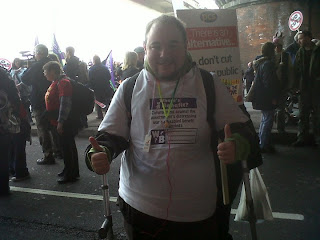
Thankfully once we'd made it through the crowd and the march set off there were no more such access fail dramas. As a result I began to really enjoy myself. The following 3 photos were taken by Emsy during the march:
>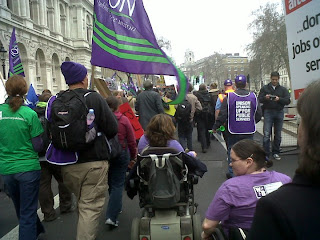
We made it into Hyde Park at about 1pm (after what seemed like quite a long human traffic jam at Hyde Park Corner). Most of us quickly nipped to the loo and then headed off to Soho Square for the UK Uncut comedy at 2. I didn't want to stick around in Hyde Park for the rally mainly because Mr "I'm in favour of cutting disability benefits" Miliband was speaking. I feared my anger at him would cause me to regress a few evolutionary steps and start flinging faeces.
I've always been disabled, but until about 5 years ago I was perfectly "healthy"; I was free from illness. For many people there's a massive overlap between "illness" and "impairment", but there's also some differences too. So I've always had a rubbish skeleton but before I acquired a plethora of illnesses unrelated to my mobility impairment I used to do that working-for-a-living thing.
I used to be a stand-up comic. Yes, I'm aware of the irony of a wheelchair-using stand-up.
On Friday evening while I was in the supermarket shopping for more T-shirts to iron the WtB logo onto a thought occurred to me: "It's comedy against the cuts. I'm doing all this stuff about the cuts to disability benefits and I have a background in comedy; I should be speaking." So I emailed the organisers and asked if I could do a short set. The reply I got back was "the line up's pretty full, but we'll try and fit you in." But in the end (and with a little help from the lovely Johann) I ended up on the bill.
This photo by Chris Coltrane who compered the gig shows what the crowd looked like from where the acts were (and makes me happy that I ironed the WtB logo onto the back of my T-shirt):
That's Josie Long performing. She opened the show. The crowd had gotten much, much, bigger by the time I went on. This CiF piece estimates there were nearly 1000 people watching the show. I wouldn't have thought there were quite that many, but there were certainly a couple of hundred.
Against all the odds I had a brilliant gig. Look, people were smiling and laughing!
Photo by Noa Bodner
If you look you can even see Mark Thomas laughing along in that pic. I'm actually quite proud of that as he is, basically, the industry standard to which all political comedy gets compared.
I say "against all the odds" because by rights I really should have died on my arse. It's 3 and a half years since I last gigged due to becoming too ill to carry on with the comedy thang. Usually if you take a break from comedy for 3 and a half weeks you come back to find your timing's a little off and your rhythm's a bit out. And I wasn't doing tried and tested material, I was doing stuff that I'd written 12 hours earlier because I only had the idea to ask to go on about 18 hours before I ended up on "stage". I shouldn't have been "in shape" enough to deal with a heckler and turn around a joke that was a bit of a dud. OK, the heckler was very nice and friendly but it's still an interruption to your rhythm and you need to regain control and come out on top with a laugh.
Somehow it was all OK. Sure, it wasn't my best gig ever but given everything going against me it went so much better than I could ever possibly have dreamed of.
In the past I used to mix up jokes about disability issues and other stuff because if I'd only talked about disability I'd never have been able to hold the attention of a non-disabled audience. But given that Saturday was such a political gig and the reason I'd asked to speak was to talk about benefits I did a set solely about cuts to disability benefits. The only reaction I was really expecting was some polite applause when I finished from people thinking "aw, wasn't that nice the disabled woman telling us about benefits." I wasn't expecting such a warm response and to come off stage to have all my friends hug me at once. It was like being mauled by an octopus, but in a nice way.
I've always thought that comedy had a wonderful capacity for education, another reason I really wanted to speak. So I was chuffed to bits when I got home to read this in The Guardian's Live Blog about the day:
I just spoke to two teenagers aged 17 and 19 who have come from the comedy show in Soho Square, and they said that what they heard there made them think more than anything they have ever learnt at school. It's their first demonstration and when I asked why they came they said they realised that the demonstration is about more than just the UK.
They can understand the connection between the shops and the banks that people are targetting and the global situation that is effecting everyone. They've heard Mark Thomas and a disabled comedian and Johann Hari speak. For these teenagers the protest is absolutely opening their minds to a much wider picture.
Noa, who snapped that pic of me in action, said:
you rocked it woman, it was FUNNY and also very disturbing to learn a few of the stories you shared. many thanks and please keep healthy and get back on stage where you belong!
I'm absolutely thrilled that I opened some people's eyes to what's going on for disabled people in the UK. There's a couple of extracts from my set in the Laugh Out London podcast.
I left Soho Square on such an adrenaline high. I'd taken a huge gamble in asking to do a set but it absolutely paid off. I would have skipped home if I could, you know, skip.
Then came the sadness. I love doing stand up so much. It's such an amazing feeling when you've got hundreds of people laughing at jokes you wrote, and Saturday was a reminder of just how thrilling it is. It's so painful that I'm not well enough to perform any more. I have good days and bad, Saturday was obviously a good day. But the sheer frequency of the bad days means that I can't book gigs more than 14 hours in advance because I can never guarantee that I'll be well enough to show up. It doesn't matter if you have a legitimate reason for not showing up to a gig, if you let a promoter down they're not going to book you again and will very possibly bad-mouth you to other promoters. I have this thing that I love doing, and Saturday reminded me that I'm actually reasonably good at it, but my health prevents me from pursuing it. And the government and tabloids really think I'd rather be stuck at home claiming benefits than out following my dreams?
The other element of sadness on Saturday night came from watching BBC News attributing the Black Bloc protesters smashing things up to UK Uncut. UK Uncut are a group of peaceful protesters who'd given me this wonderfully enjoyable afternoon of comedy in a park. And here these lovely people were being falsely accused of violence and vandalism. It was deeply disappointing.
Despite the day starting with access fail and ending in sadness I don't think I'll ever forget that chunk of a few hours in the middle where I had the best time I've had in years.
Cross-posted at Where's the Benefit?
20 February 2011
♫...London calling? Yes, I was there too...♫
Life, the universe and everything tried to stop me from making it yesterday. From nose bleeds to parking nightmares, I had it all go wrong. I was tempted to just declare "fuck it" and go back to bed (having only managed 3 hours sleep. Not cos I was doing anything fun; I just laid there staring at the ceiling all night). And once I arrived at Congress House I spent most of the day on the verge of a temper tantrum and wishing I had spent the day sleeping.
The first time I heard anyone mention the word "disability" was during the "does the left lead online?" session at 3:30pm. I could've kissed Laurie Penny for bringing up the fact that Labour abolished Incapacity Benefit and talking about the online grassroots disability movement.
This was after I'd spent hours listening to members of other discriminated-against groups tell me that their group was the hardest hit of all.
Now, some of those groups are groups that I also belong to (women, LGBT, working class) so I absolutely understand that they/we are disproportionately hit when you compare us to straight, white, middle class men. But to claim that those groups are the hardest hit group is just not true.
For example; I listened to Dianne Abbott talk about how women and people from a minority ethnic background will be the hardest hit by the cuts. She talked about how people from those groups are more likely to be made redundant because they're more likely to work in the public and voluntary sectors. The same is true of disabled people and for the same reasons; employers in the public and third sectors are slightly less likely to be discriminatory.
But in addition to being likely to lose their jobs due to redundancies in the public sector and funding cuts to the voluntary sector, disabled employees in those sectors are likely to have to quit work due to Access to Work cut backs. Disabled people are also facing cuts to their care packages (which may result in having to give up work due to not having someone to get you out of bed of a morning!) and loss of their DLA.
Abbott also talked about how women and black and minority ethnic folks are more likely to live below the poverty line. This is also true for disabled people. But on top of the current levels of poverty disabled people are facing the prospect of having to pay even more towards their care, losing their incapacity benefit due to the brutal new assessment measures and losing their DLA. People already have to pay more on being disabled than they get back in the form of DLA.
I am not, at all, suggesting that I think that other minorities will not be hit hard. I'm just starting to get annoyed with non-disabled people claiming their group will be hit "hardest" when that is not the case because disabled people experience the same issues but with some extra crap on top.
The complete absence of disability issues from the panels infuriated me too. Why weren't Transport for All represented on the panel talking about transport? Why weren't DPAC, The Broken of Britain or Where's the Benefit represented on the panel about how we're not all in this together? That disabled people are not only being cruelly hit by the cuts but also excluded from discussions about the cuts reminds me of a post I wrote last year about us being the lowest of the low, and something I wrote more recently about how anti-cuts campaigners prefer books and trees to us.
As I said, the session about the left online improved my mood massively. Not only was there an acknowledgement that disabled people exist, I also had a good conversation afterwards with some UKUncutters (apparently my reputation is starting to precede me).
Then there was the final plenary session. I may be utterly furious with the Labour party for not only the recent history in which they scrapped IB and gave us ESA, but also their ongoing support for the coalition cuts to DLA; but I still intend to vote for Livingstone because the improvements he made to the accessibility of London's transport had such a positive impact on my life. However even he managed to piss me off more than somewhat with his closing speech: He talked about how equal London is in term of race, religion and sexual orientation, but how unequal London is in terms of class and wealth. I think it says something about the inequality of disabled people that we didn't even get a namecheck.
I would love to live in a progressive London. Somehow I don't see that happening any time soon when London's so-called progressives turn up to Progressive London denying the existence of around 18% of the population.
The first time I heard anyone mention the word "disability" was during the "does the left lead online?" session at 3:30pm. I could've kissed Laurie Penny for bringing up the fact that Labour abolished Incapacity Benefit and talking about the online grassroots disability movement.
This was after I'd spent hours listening to members of other discriminated-against groups tell me that their group was the hardest hit of all.
Now, some of those groups are groups that I also belong to (women, LGBT, working class) so I absolutely understand that they/we are disproportionately hit when you compare us to straight, white, middle class men. But to claim that those groups are the hardest hit group is just not true.
For example; I listened to Dianne Abbott talk about how women and people from a minority ethnic background will be the hardest hit by the cuts. She talked about how people from those groups are more likely to be made redundant because they're more likely to work in the public and voluntary sectors. The same is true of disabled people and for the same reasons; employers in the public and third sectors are slightly less likely to be discriminatory.
But in addition to being likely to lose their jobs due to redundancies in the public sector and funding cuts to the voluntary sector, disabled employees in those sectors are likely to have to quit work due to Access to Work cut backs. Disabled people are also facing cuts to their care packages (which may result in having to give up work due to not having someone to get you out of bed of a morning!) and loss of their DLA.
Abbott also talked about how women and black and minority ethnic folks are more likely to live below the poverty line. This is also true for disabled people. But on top of the current levels of poverty disabled people are facing the prospect of having to pay even more towards their care, losing their incapacity benefit due to the brutal new assessment measures and losing their DLA. People already have to pay more on being disabled than they get back in the form of DLA.
I am not, at all, suggesting that I think that other minorities will not be hit hard. I'm just starting to get annoyed with non-disabled people claiming their group will be hit "hardest" when that is not the case because disabled people experience the same issues but with some extra crap on top.
The complete absence of disability issues from the panels infuriated me too. Why weren't Transport for All represented on the panel talking about transport? Why weren't DPAC, The Broken of Britain or Where's the Benefit represented on the panel about how we're not all in this together? That disabled people are not only being cruelly hit by the cuts but also excluded from discussions about the cuts reminds me of a post I wrote last year about us being the lowest of the low, and something I wrote more recently about how anti-cuts campaigners prefer books and trees to us.
As I said, the session about the left online improved my mood massively. Not only was there an acknowledgement that disabled people exist, I also had a good conversation afterwards with some UKUncutters (apparently my reputation is starting to precede me).
Then there was the final plenary session. I may be utterly furious with the Labour party for not only the recent history in which they scrapped IB and gave us ESA, but also their ongoing support for the coalition cuts to DLA; but I still intend to vote for Livingstone because the improvements he made to the accessibility of London's transport had such a positive impact on my life. However even he managed to piss me off more than somewhat with his closing speech: He talked about how equal London is in term of race, religion and sexual orientation, but how unequal London is in terms of class and wealth. I think it says something about the inequality of disabled people that we didn't even get a namecheck.
I would love to live in a progressive London. Somehow I don't see that happening any time soon when London's so-called progressives turn up to Progressive London denying the existence of around 18% of the population.
18 February 2011
P and enforced sterilisation
People who've been reading this blog for years (yes, both of you) might remember that the subject of whipping the wombs out of disabled young women is something I've written about before: First there was Ashley X and then Katie Thorpe.
There's been another case in the news this week, that of the woman known only as "P". This case is a bit different to the previous two mentioned: In those the parents basically just wanted to prevent their child from growing up because disabled children are cute while disabled adults are icky. In this case it's about attempting to prevent P from the heartbreak of having children taken into care. So I have a little more sympathy for what P's parents are trying to do, even though I think sterilisation against P's will is wrong.
The issue at heart is one of poor social care. P wants a big family, her parents don't want P to have lots of children only for them to be taken into care but her parents don't have the capacity to support her in raising more than 2 children.
My parents are/were (mum died a couple of years ago) disabled. They had different types of impairments to P; they both have/had physical impairments while P has learning difficulties. But the end result is still the same; they needed assistance to raise a child and run a household.
My parents needed support with physical things like cleaning, lifting heavy saucepans and carrying the shopping in from the car. I'm assuming P needs help with understanding managing domestic tasks, planning recipes and managing a shopping list. At the end of the day both sets of parents require help with housework, cooking and shopping. So why did my parents get a care package from social services but P has to live with her parents to get the support she needs 'Big Society' style? Especially when her parents have a limit on what support they can provide and that's at odds with what P herself wants?
I think it's horrific that we're living in a time when the state would rather spend money on a court case in which the future of a women's uterus is decided and potentially surgery against her will; rather than spending the money on social care to allow that woman to live the life she wants to live and have the family she wants to have.
There's been another case in the news this week, that of the woman known only as "P". This case is a bit different to the previous two mentioned: In those the parents basically just wanted to prevent their child from growing up because disabled children are cute while disabled adults are icky. In this case it's about attempting to prevent P from the heartbreak of having children taken into care. So I have a little more sympathy for what P's parents are trying to do, even though I think sterilisation against P's will is wrong.
The issue at heart is one of poor social care. P wants a big family, her parents don't want P to have lots of children only for them to be taken into care but her parents don't have the capacity to support her in raising more than 2 children.
My parents are/were (mum died a couple of years ago) disabled. They had different types of impairments to P; they both have/had physical impairments while P has learning difficulties. But the end result is still the same; they needed assistance to raise a child and run a household.
My parents needed support with physical things like cleaning, lifting heavy saucepans and carrying the shopping in from the car. I'm assuming P needs help with understanding managing domestic tasks, planning recipes and managing a shopping list. At the end of the day both sets of parents require help with housework, cooking and shopping. So why did my parents get a care package from social services but P has to live with her parents to get the support she needs 'Big Society' style? Especially when her parents have a limit on what support they can provide and that's at odds with what P herself wants?
I think it's horrific that we're living in a time when the state would rather spend money on a court case in which the future of a women's uterus is decided and potentially surgery against her will; rather than spending the money on social care to allow that woman to live the life she wants to live and have the family she wants to have.
06 February 2011
Hollywood Images of Disability
Hat tip to Wheelie Catholic for posting this video.
Edit 16/3/11: The video has been deleted from Vimeo. :-(
Hollywood Images of Disability (CHF EDIT) from salome chasnoff on Vimeo.
Edit 16/3/11: The video has been deleted from Vimeo. :-(
02 February 2011
SPOILER WARNING: Handle with Care by Jodi Picoult
The back of the book blurb essentially says that the book is about the parents of a kid with OI who decide to sue their obstetrician for "wrongful birth" in order to pay Willow's medical bills.
After the jump spoilers will abound. So if you haven't read it and don't want to be spoiled, don't read on.
After the jump spoilers will abound. So if you haven't read it and don't want to be spoiled, don't read on.
06 January 2011
Why I'm not surprised that no-one helped Simone Back
You've probably read about Simone Back by now. It seems there's a global wondering of how people could possibly ignore a suicide note. The world seems stunned that no-one helped her as she lay dying after so publicly declaring that she'd ODed.
I think it's so desperately sad that no-one came to her aid, but I can't even feign a bit of surprise that people bitched about her rather than saving her because I know what it's like to be unwell and for people to become desensitised to you mentioning it. For the most part my own health problems are physical rather than mental but I think the principal is the same across all illnesses of whatever type.
When Simone posted the words "Took all my pills be dead soon bye bye everyone," one of her "friends" replied with:
"She ODs all the time and she lies."
Now I don't know Simone, I've never met her. I only know what I've read in a few news articles. But that cold, unfeeling sentence from one of her "friends" would suggest that Simone has attempted suicide in the past and was quite open about it.
When you talk about your ill health all the time, be it mental or physical, people seem to stop giving a shit after a while. Like you're a broken record and the disjointed tune will remain the same no matter what intervention so people just ignore that track and wait for the next one. Except in the online worlds of Twitter and Facebook it's not like you've got to wait for the dodgy track to play out to get to the next song like you did with vinyl or tapes: Twitter and Facebook are more akin to mp3 players and you can just scroll past the corrupt song onto the next one.
So when I mention feeling unwell my online friends don't respond with concern anymore, they just scroll past onto the next update; me mentioning my shitty health is the TwitBookSpace equivalent of that corrupt file in your iTunes library.
I've been having a bad day today. Earlier in the week I had a reminder of what my life used to be like when I had that precious thing called health. While I had a fun evening out on Tuesday it has since got me contemplating all the things I've lost and the things I had the potential to be which are now dreams that'll never be realised. That contemplation made me cry. My body is constantly on the lookout for any excuse to hurt and via a couple of degrees of separation the emotional upset ended up causing me physical pain.
My tweets are set up to automatically update my Facebook status. So this morning when I tweeted that I was having a bad day that fact was broadcast to my 407 Twitter followers and 376 Facebook friends. The number of people that replied? 3. Two Facebook friends I know IRL and one Twitter follower who's only just started following me so is therefore presumably not sick to the back teeth of me moaning yet.
A couple of hours, one nap and many drugs later I tweeted that I'd managed to cry myself into physical pain. This time it warranted even less of a response: Just the one person who I only met last month said that she was sorry to hear I was having a sucky time. Again, I'm sure that once she's known me for more than three weeks she too will lose interest in me feeling rough.
I think stereotypical British stoicism is part of the problem. We're not supposed to talk about negative feelings, whether they be physical or mental. On Tuesday I had a brief conversation with someone I haven't seen for over 5 years: Since before I became "ill" (I've always had a shitty skeleton but there's a difference between "illness" and "impairment". Until 5.5 years ago I was mobility impaired but free from illness). She's doesn't know anything about me other than that I have a very loud laugh, but in the polite and conversational way that you do she asked on Tuesday "how have you been?"
I actually had to pause for a minute. "Do I answer honestly or do I just say what you're supposed to say which is 'fine'? She doesn't know me so doesn't need to hear my shit. But on the other hand I hate lying..." I opted for just shrugging because I couldn't bear to deviate from the social norm enough to say "not at all well actually." Except I did then explain that I'd been ill because I suck at keeping my trap shut.
With social rules dictating that we're not even supposed to answer "how are you?" honestly unless the answer is positive it's not entirely surprising that there is such a backlash against people like Simone who'll publicly state "I hurt" rather than keeping their British stiff upper lip.
I'm not going to pretend that I'm above the social rules and desensitisation. I have Twitter and Facebook friends with painful diagnoses and I don't reply every time they say "sneezed and broke a rib" or "dislocated my shoulder relocating my knee." I've rolled my eyes at friends who always cry when they're drunk because with inhibitions lowered the stiff upper lip falters and their sadness slips out. I'm not proud of it, but sometimes you don't want to listen to that dodgy mp3 and you want to listen to a new song you've never heard before. Or at least you want to listen to a song that'll play without scritching.
Then there are those who will criticise you for being open about how you're feeling. Those who'll attack you for complaining about feeling crappy. You wouldn't believe the number of times as a child I was told to shut the fuck up screaming about my broken bones because my distress would upset other people. The TwitBookSpace equivalent I guess would be unfriending/blocking someone for being honest about how they feel, giving a bitchy remark as a parting shot. Or deleting that corrupt file from your iTunes library.
When it comes to mental health we, as a culture, want to hear about it even less than physical health. If people are going to ignore me moaning about being in physical pain you can be sure they'll steer well clear of someone moaning about being in emotional pain. And if people can react with hostility to a cute small child screaming because they've got 3 freshly broken long bones and no painkillers in their system is it really surprising that people are hostile to someone saying "I'm killing myself"?
When it comes to talk of suicide we typically have 2 responses:
I find it greatly alarming that we get a lot of anonymous commenters on WtB talking about how they plan to kill themselves if/when they lose their benefits. Sadly we have heard from people who don't believe those people actually are planning to kill themselves because of the myth that genuinely suicidal people don't talk about it.
As for point 2, I have an example in mind. Just before Christmas the wonderful Incurable Hippie read this article and started begging people in the Oxford area via social networks to go down to Wolvercote lock and take Mr Payne warm clothes and food and a puncture repair kit because being in Sheffield she wasn't in a position to physically help him herself.
Someone she asked refused to retweet the link because Mr Payne was suicidal and he felt that Mr Payne's aid should only come from The Professionals. I'm pretty sure that a thermos full of Heinz soup reheated by an amateur would've been satisfactory and that Payne didn't really need any food to be prepared by Jamie Oliver.
Yes, I do realise that the gentleman in question wasn't referring to pro chefs. But are we really that afraid of mental illness that taking hot soup to a cold depressed person is too scary? But taking soup to a cold person who's full of joie de vivre would be OK? Isn't it conceivable that if Mr Payne was treated like a human being instead of a social problem that he might not actually have been feeling suicidal in the first place?
We have a cultural thing about not talking about how we feel unless our feelings are all rainbows and sweeties. We ignore people who break that rule or are sometimes even hostile towards the social deviators. As a culture we have a big problem with people who'll speak out about feeling suicidal. Yet people are somehow still surprised that no-one rushed to Back's aid? Saddened, of course. But surprised? Really?
Edit: Just wanted to clarify that I don't think it's an internet problem; people have the same reaction in real life towards people who talk about illness regularly. I think it's more that ill people are supposed to be stoic about their pain and so those who do talk about it are castigated. If anything I think the problem is worse in real life: In my experience people actively avoid those who moan about their health all the time. Online people tend to just avoid the health-related updates rather than avoiding the ill person completely.
I also wanted to touch on the fact that every article I've read about Back quotes Graham Bell from the Brighton and Hove Depression Alliance as saying:
Really? Funny thing about illness is it makes you ill. When you're in too much pain to get out of bed, or when you're too depressed to get out of bed, or when you're too stoned on medication to get out of bed how the hell is one supposed to get out there and maintain real-life friendships? I frequently go weeks and weeks without talking to friends in person. If it weren't for my online social life I'd have no way of keeping in touch with people at all. In person friendships are great for those with the health to manage them but who am I going to forge RL friendships with from the confines of my flat?
I think it's so desperately sad that no-one came to her aid, but I can't even feign a bit of surprise that people bitched about her rather than saving her because I know what it's like to be unwell and for people to become desensitised to you mentioning it. For the most part my own health problems are physical rather than mental but I think the principal is the same across all illnesses of whatever type.
When Simone posted the words "Took all my pills be dead soon bye bye everyone," one of her "friends" replied with:
"She ODs all the time and she lies."
Now I don't know Simone, I've never met her. I only know what I've read in a few news articles. But that cold, unfeeling sentence from one of her "friends" would suggest that Simone has attempted suicide in the past and was quite open about it.
When you talk about your ill health all the time, be it mental or physical, people seem to stop giving a shit after a while. Like you're a broken record and the disjointed tune will remain the same no matter what intervention so people just ignore that track and wait for the next one. Except in the online worlds of Twitter and Facebook it's not like you've got to wait for the dodgy track to play out to get to the next song like you did with vinyl or tapes: Twitter and Facebook are more akin to mp3 players and you can just scroll past the corrupt song onto the next one.
So when I mention feeling unwell my online friends don't respond with concern anymore, they just scroll past onto the next update; me mentioning my shitty health is the TwitBookSpace equivalent of that corrupt file in your iTunes library.
I've been having a bad day today. Earlier in the week I had a reminder of what my life used to be like when I had that precious thing called health. While I had a fun evening out on Tuesday it has since got me contemplating all the things I've lost and the things I had the potential to be which are now dreams that'll never be realised. That contemplation made me cry. My body is constantly on the lookout for any excuse to hurt and via a couple of degrees of separation the emotional upset ended up causing me physical pain.
My tweets are set up to automatically update my Facebook status. So this morning when I tweeted that I was having a bad day that fact was broadcast to my 407 Twitter followers and 376 Facebook friends. The number of people that replied? 3. Two Facebook friends I know IRL and one Twitter follower who's only just started following me so is therefore presumably not sick to the back teeth of me moaning yet.
A couple of hours, one nap and many drugs later I tweeted that I'd managed to cry myself into physical pain. This time it warranted even less of a response: Just the one person who I only met last month said that she was sorry to hear I was having a sucky time. Again, I'm sure that once she's known me for more than three weeks she too will lose interest in me feeling rough.
I think stereotypical British stoicism is part of the problem. We're not supposed to talk about negative feelings, whether they be physical or mental. On Tuesday I had a brief conversation with someone I haven't seen for over 5 years: Since before I became "ill" (I've always had a shitty skeleton but there's a difference between "illness" and "impairment". Until 5.5 years ago I was mobility impaired but free from illness). She's doesn't know anything about me other than that I have a very loud laugh, but in the polite and conversational way that you do she asked on Tuesday "how have you been?"
I actually had to pause for a minute. "Do I answer honestly or do I just say what you're supposed to say which is 'fine'? She doesn't know me so doesn't need to hear my shit. But on the other hand I hate lying..." I opted for just shrugging because I couldn't bear to deviate from the social norm enough to say "not at all well actually." Except I did then explain that I'd been ill because I suck at keeping my trap shut.
With social rules dictating that we're not even supposed to answer "how are you?" honestly unless the answer is positive it's not entirely surprising that there is such a backlash against people like Simone who'll publicly state "I hurt" rather than keeping their British stiff upper lip.
I'm not going to pretend that I'm above the social rules and desensitisation. I have Twitter and Facebook friends with painful diagnoses and I don't reply every time they say "sneezed and broke a rib" or "dislocated my shoulder relocating my knee." I've rolled my eyes at friends who always cry when they're drunk because with inhibitions lowered the stiff upper lip falters and their sadness slips out. I'm not proud of it, but sometimes you don't want to listen to that dodgy mp3 and you want to listen to a new song you've never heard before. Or at least you want to listen to a song that'll play without scritching.
Then there are those who will criticise you for being open about how you're feeling. Those who'll attack you for complaining about feeling crappy. You wouldn't believe the number of times as a child I was told to shut the fuck up screaming about my broken bones because my distress would upset other people. The TwitBookSpace equivalent I guess would be unfriending/blocking someone for being honest about how they feel, giving a bitchy remark as a parting shot. Or deleting that corrupt file from your iTunes library.
When it comes to mental health we, as a culture, want to hear about it even less than physical health. If people are going to ignore me moaning about being in physical pain you can be sure they'll steer well clear of someone moaning about being in emotional pain. And if people can react with hostility to a cute small child screaming because they've got 3 freshly broken long bones and no painkillers in their system is it really surprising that people are hostile to someone saying "I'm killing myself"?
When it comes to talk of suicide we typically have 2 responses:
- Disbelief
- A desire to not get involved in case we make matters worse
It is a myth that people who talk about suicide don't go through with it.
I find it greatly alarming that we get a lot of anonymous commenters on WtB talking about how they plan to kill themselves if/when they lose their benefits. Sadly we have heard from people who don't believe those people actually are planning to kill themselves because of the myth that genuinely suicidal people don't talk about it.
As for point 2, I have an example in mind. Just before Christmas the wonderful Incurable Hippie read this article and started begging people in the Oxford area via social networks to go down to Wolvercote lock and take Mr Payne warm clothes and food and a puncture repair kit because being in Sheffield she wasn't in a position to physically help him herself.
Someone she asked refused to retweet the link because Mr Payne was suicidal and he felt that Mr Payne's aid should only come from The Professionals. I'm pretty sure that a thermos full of Heinz soup reheated by an amateur would've been satisfactory and that Payne didn't really need any food to be prepared by Jamie Oliver.
Yes, I do realise that the gentleman in question wasn't referring to pro chefs. But are we really that afraid of mental illness that taking hot soup to a cold depressed person is too scary? But taking soup to a cold person who's full of joie de vivre would be OK? Isn't it conceivable that if Mr Payne was treated like a human being instead of a social problem that he might not actually have been feeling suicidal in the first place?
We have a cultural thing about not talking about how we feel unless our feelings are all rainbows and sweeties. We ignore people who break that rule or are sometimes even hostile towards the social deviators. As a culture we have a big problem with people who'll speak out about feeling suicidal. Yet people are somehow still surprised that no-one rushed to Back's aid? Saddened, of course. But surprised? Really?
Edit: Just wanted to clarify that I don't think it's an internet problem; people have the same reaction in real life towards people who talk about illness regularly. I think it's more that ill people are supposed to be stoic about their pain and so those who do talk about it are castigated. If anything I think the problem is worse in real life: In my experience people actively avoid those who moan about their health all the time. Online people tend to just avoid the health-related updates rather than avoiding the ill person completely.
I also wanted to touch on the fact that every article I've read about Back quotes Graham Bell from the Brighton and Hove Depression Alliance as saying:
“People need to be friends in the real world as well as in the online world.”
Really? Funny thing about illness is it makes you ill. When you're in too much pain to get out of bed, or when you're too depressed to get out of bed, or when you're too stoned on medication to get out of bed how the hell is one supposed to get out there and maintain real-life friendships? I frequently go weeks and weeks without talking to friends in person. If it weren't for my online social life I'd have no way of keeping in touch with people at all. In person friendships are great for those with the health to manage them but who am I going to forge RL friendships with from the confines of my flat?
25 November 2010
Thoughts on the student protests, policing and the media
I'm so proud of British students right now. I'm especially proud of Britain's schoolchildren and sixth formers who protested yesterday. I was especially pleased when BBC News reported on sixth formers from Cambridge protesting, though I felt a slight pang of jealousy: When I was an oppressed1 and politically aware sixth former in Cambridge I'd have loved nothing more than to march through the streets to protect my future.
Of course, the media portrayal has mostly been of the tiny number of students who committed acts of damage to property, especially that police van. What most of the mainstream media isn't reporting (in fact I think only The Guardian has) is the number of protesters who tried to protect the van. In this video you can see some of them, and there's this iconic image from The Guardian:

At one point the BBC reporter in the Commons explained why politicians and the media are so keen to report on the poorly behaved few rather than the well behaved majority. He was reporting to the camera what a politician had told him (but I'm afraid I didn't catch who, the trouble with live TV). I'm paraphrasing him, but not much (and only because I didn't get to write/type down his exact words):
On one hand on our TV screens we're seeing looped footage of a few protesters smashing up an unoccupied police van (which some speculate was put there as bait) in the hope that it'll make the majority think "hmm, fees are good! Let's teach these brutal young things a lesson!" On the other hand what we're not seeing is the brutality from the other side.
Thanks to camera phones and the internet incidents of police brutality are harder to hide. And yesterday saw some unforgivable behaviour. Throughout the day there were many tweets being rapidly retweeted with content along the lines of "Officer abc123 kicked a 15 year old girl."
Some actual examples:
1 The Disability Discrimination Act was written while I was in my first year of sixth form. However it didn't come into effect until years later.
Of course, the media portrayal has mostly been of the tiny number of students who committed acts of damage to property, especially that police van. What most of the mainstream media isn't reporting (in fact I think only The Guardian has) is the number of protesters who tried to protect the van. In this video you can see some of them, and there's this iconic image from The Guardian:

At one point the BBC reporter in the Commons explained why politicians and the media are so keen to report on the poorly behaved few rather than the well behaved majority. He was reporting to the camera what a politician had told him (but I'm afraid I didn't catch who, the trouble with live TV). I'm paraphrasing him, but not much (and only because I didn't get to write/type down his exact words):
If the protests get violent the public will lose sympathy with the protesters and support our plans for higher fees.
On one hand on our TV screens we're seeing looped footage of a few protesters smashing up an unoccupied police van (which some speculate was put there as bait) in the hope that it'll make the majority think "hmm, fees are good! Let's teach these brutal young things a lesson!" On the other hand what we're not seeing is the brutality from the other side.
Thanks to camera phones and the internet incidents of police brutality are harder to hide. And yesterday saw some unforgivable behaviour. Throughout the day there were many tweets being rapidly retweeted with content along the lines of "Officer abc123 kicked a 15 year old girl."
Some actual examples:
- Cambridge student demo: policeman punched student in the face
- Police violence at Student Protest London 24 November
- Laurie Penny on the children trapped inside the Whitehall kettle until late at night when the temperature had dropped to freezing
1 The Disability Discrimination Act was written while I was in my first year of sixth form. However it didn't come into effect until years later.
13 August 2010
Where's the Benefit?
A bunch of us made a new blog all about the War on Welfare Claimants called Where's the Benefit?. Go on, have a look.
24 July 2010
The lowest of the low
Being female, gay and disabled1 you'd think I'd experience 3 times as much discrimination as a disabled but otherwise socially privileged bloke, right?
Wrong. All the discrimination I ever experience is disablism.
Not only is experiencing daily disablist acts (like not being able to get into a brand new café) frustrating, there's also the constant reminders that discrimination against disabled people provokes the least outrage among society at large out of all the isms.
Easter weekend 2009 there was the amazonfail brouhaha. It doesn't matter if someone from amazon.fr pressed the wrong button which "accidentally" meant rankings were stripped from any books to do with homosexuality or sex and disability. Where the conscious and deliberate disablism occurred was in the web/media frenzy. Everyone on the planet cried "homophobia" in their tweets, blog posts and news articles. Only a tiny, tiny smattering of people gave a crap that books on disability and sexuality had been affected too.
A couple of months ago the LGBT Labour party conference were refused drinks in a London pub. The story of homophobic discrimination spread across the internet like wildfire and was global news within a couple of hours. My gut reaction upon reading the story was to tweet Greencoat Boy: The gay in me is horrified. The disabled in me says "so what? Disabled people get refused service DAILY and it's not news.".
Two hours later my point got illustrated perfectly. I read this story of a wheelchair-using woman being refused service in a restaurant on the very same day. Naturally I tweeted the link. The story of a homophobic bar manager was tweeted and retweeted thousands and thousands of times. How many people retweeted the tale of a disablist restaurant manager? Two. Not two thousand; just two.
Yesterday it was news that a niqab-wearing young Muslim woman and her friend were refused entry onto a bus for "being a threat". I'm refused entry to roughly one in 5 of the buses I try to board because I'm a wheelchair user. Very often the driver doesn't even have the balls to tell me he's going to refuse me access, he just pulls up at the stop, doesn't get the ramp out, allows able-bodied2 passengers to board and then drives off.
Where's my news story in the top 10 on the BBC News website? Where's my "urgent investigation" into the discrimination I faced?
Superaleja once referred to "multiple layers of discrimination, like a crip-fail onion," which I think perfectly describes the 3 situations I've written about here. First disabled people get discriminated against, then there's the second layer of discrimination where we're denied the public outcry of horror that would be extended to the same discrimination being committed against any other minority group.
1 I have been told on many an occasion that it's a shame I'm not black too. During my stand up days (before I became too ill to carry on) I had an 'anti-fan' in Brighton who came to see me every time I gigged in the city to accuse me of being racist for telling the story of how daft people sometimes say "it's a shame you're not black." Being so hated really made me feel like I was doing the job properly.
2 I'm deliberately using the phrase "able-bodied" as the opposite of "physically impaired". There's a chance that some of the people boarding the bus are both disabled and able-bodied.
Wrong. All the discrimination I ever experience is disablism.
Not only is experiencing daily disablist acts (like not being able to get into a brand new café) frustrating, there's also the constant reminders that discrimination against disabled people provokes the least outrage among society at large out of all the isms.
Easter weekend 2009 there was the amazonfail brouhaha. It doesn't matter if someone from amazon.fr pressed the wrong button which "accidentally" meant rankings were stripped from any books to do with homosexuality or sex and disability. Where the conscious and deliberate disablism occurred was in the web/media frenzy. Everyone on the planet cried "homophobia" in their tweets, blog posts and news articles. Only a tiny, tiny smattering of people gave a crap that books on disability and sexuality had been affected too.
A couple of months ago the LGBT Labour party conference were refused drinks in a London pub. The story of homophobic discrimination spread across the internet like wildfire and was global news within a couple of hours. My gut reaction upon reading the story was to tweet Greencoat Boy: The gay in me is horrified. The disabled in me says "so what? Disabled people get refused service DAILY and it's not news.".
Two hours later my point got illustrated perfectly. I read this story of a wheelchair-using woman being refused service in a restaurant on the very same day. Naturally I tweeted the link. The story of a homophobic bar manager was tweeted and retweeted thousands and thousands of times. How many people retweeted the tale of a disablist restaurant manager? Two. Not two thousand; just two.
Yesterday it was news that a niqab-wearing young Muslim woman and her friend were refused entry onto a bus for "being a threat". I'm refused entry to roughly one in 5 of the buses I try to board because I'm a wheelchair user. Very often the driver doesn't even have the balls to tell me he's going to refuse me access, he just pulls up at the stop, doesn't get the ramp out, allows able-bodied2 passengers to board and then drives off.
Where's my news story in the top 10 on the BBC News website? Where's my "urgent investigation" into the discrimination I faced?
Superaleja once referred to "multiple layers of discrimination, like a crip-fail onion," which I think perfectly describes the 3 situations I've written about here. First disabled people get discriminated against, then there's the second layer of discrimination where we're denied the public outcry of horror that would be extended to the same discrimination being committed against any other minority group.
1 I have been told on many an occasion that it's a shame I'm not black too. During my stand up days (before I became too ill to carry on) I had an 'anti-fan' in Brighton who came to see me every time I gigged in the city to accuse me of being racist for telling the story of how daft people sometimes say "it's a shame you're not black." Being so hated really made me feel like I was doing the job properly.
2 I'm deliberately using the phrase "able-bodied" as the opposite of "physically impaired". There's a chance that some of the people boarding the bus are both disabled and able-bodied.
Subscribe to:
Posts (Atom)
